

|
Hearken to this text  |
When outdated meals packaging, discarded kids’s toys and different mismanaged plastic waste break down into microplastics, they grow to be even tougher to scrub up from oceans and waterways. These tiny bits of plastic additionally entice micro organism, together with those who trigger illness. Researchers are turning to microrobots for assist.
In a research in ACS Nano, a publication by the American Chemical Society, researchers describe swarms of microscale robots (microrobots) that captured bits of plastic and micro organism from water. Afterward, the microrobots have been decontaminated and reused. You may watch a video of them swarming atop the web page.
The dimensions of microplastics, which measure 5 millimeters or much less, provides one other dimension to the plastic air pollution drawback as a result of animals can eat them, doubtlessly being harmed or passing the particles into the meals chain that ends with people. Up to now, the well being results for individuals are not absolutely understood. Nevertheless, microplastics themselves aren’t the one concern.
These items entice micro organism, together with pathogens, which will also be ingested. To take away microbes and plastic from water concurrently, Martin Pumera and colleagues turned to microscale robotic techniques, comprised of many small parts that work collaboratively, mimicking pure swarms, like faculties of fish.
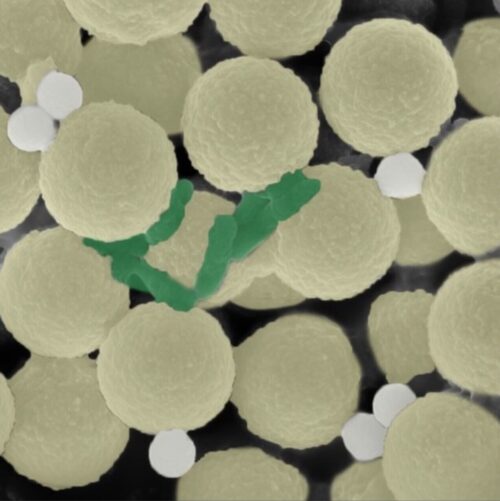
A microscope picture exhibits the microrobots (yellow) together with trapped micro organism (inexperienced) and tiny items of plastic (white). | Credit score: ACS Nano
To assemble the microrobots, the group linked strands of a positively charged polymer to magnetic microparticles, which solely transfer when uncovered to a magnetic subject. The polymer strands, which radiate from the floor of the beads, entice each plastics and microbes. And the completed merchandise — the person robots — measured 2.8 micrometers in diameter. When uncovered to a rotating magnetic subject, the robots swarmed collectively. By adjusting the variety of robots that self-organized into flat clusters, the researchers discovered that they might alter the swarm’s motion and velocity.
In lab experiments, the group replicated microplastics and micro organism within the surroundings by including fluorescent polystyrene beads (1 micrometer-wide) and actively swimming Pseudomonas aeruginosa micro organism, which might trigger pneumonia and different infections, to a water tank. Subsequent, the researchers added microrobots to the tank and uncovered them to a rotating magnetic subject for half-hour, switching it on and off each 10 seconds.
A robotic focus of seven.5 milligrams per milliliter, the densest of 4 concentrations examined, captured roughly 80% of the micro organism. In the meantime, at this identical focus, the variety of free plastic beads additionally regularly dropped, as they have been drawn to the microrobots.
Afterward, the researchers collected the robots with a everlasting magnet and used ultrasound to detach the micro organism clinging to them. They then uncovered the eliminated microbes to ultraviolet radiation, finishing the disinfection. When reused, the decontaminated robots nonetheless picked up plastic and microbes, albeit smaller quantities of each.
This microrobotic system offers a promising method for ridding water of plastic and micro organism, the researchers stated.