

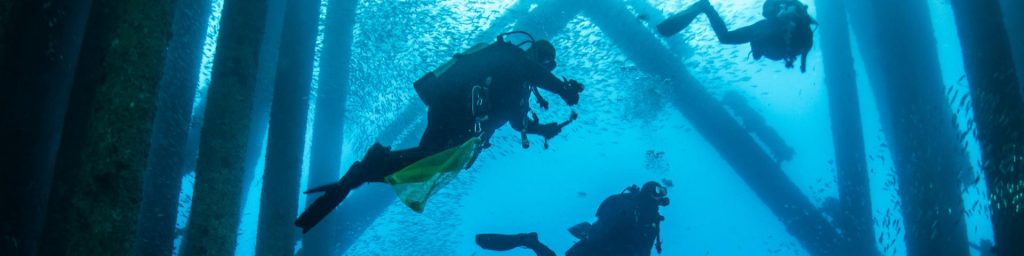
Ocean divers might quickly profit from related underwater expertise. © Kirk Wester, Shutterstock.com
By Helen Massy-Beresford
Think about seals swimming within the sea with digital tags that ship real-time water knowledge to scientists again of their laboratories. Or archaeologists close to a coast being robotically alerted when a diver trespasses on a treasured shipwreck.
Such situations have gotten attainable on account of underwater related applied sciences, which may also help monitor and defend the world’s oceans. They will additionally make clear the various remaining mysteries of the ocean.
New frontier
‘Lots of funding has been offered to firms and establishments exploring area, however we have now oceans round us that we have now not explored,’ stated Vladimir Djapic, innovation affiliate on the EU-funded TEUTA mission.
“We now have oceans round us that we have now not explored.”
– Vladimir Djapic, TEUTA
Round 70% of the Earth is roofed by oceans and greater than four-fifths of them have by no means been mapped, explored and even seen by people.
The Web of Underwater Issues, or IoUT, is a community of good, interconnected sensors and units to make speaking within the sea simpler. It contrasts with the Web of Issues, or IoT, masking all the pieces from good telephones to units that permit folks to modify on residence heating remotely,
TEUTA ran from October 2020 by way of March 2022. It helped a Croatian firm, H20 Robotics, develop and promote light-weight low-cost acoustic units and robotic platforms for underwater wi-fi networks.
‘With a restricted variety of underwater community installations earlier than, we might solely discover restricted coastal areas,’ stated Djapic, who’s chief govt officer of Zagreb-based H20 Robotics.
Advances in underwater applied sciences are anticipated to remodel many sectors together with marine biology, environmental monitoring, development and geology.
Whale-like methods
TEUTA developed acoustic expertise, which mimics the way in which whales and dolphins talk.
Acoustic waves, not like radio or optical communication ones, journey lengthy distances underwater no matter whether or not it’s murky or clear.
Distant sensors, measuring instruments, detection methods or cameras arrange at an underwater website collect knowledge then despatched to a buoy on the floor. The buoy in flip sends the data wirelessly again to base, through the cloud, with out the necessity for communication cables.
One focus space is enhancing communications between divers and land-based colleagues, based on Djapic.
‘For instance, a diver working in underwater development can ship a message to a supervisor and request extra assist or instruments or related,’ stated Djapic.
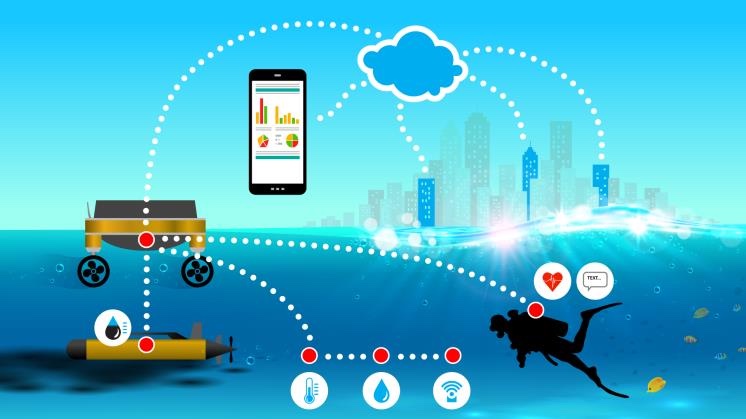
Improved underwater communications will assist join land and sea, © H2O ROBOTICS, 2023
Scientists additionally stand to learn by, for instance, having the ability to remotely activate a water-quality measuring gadget put in on the seabed from their labs.
For his or her half, archaeologists might use the expertise to assist defend weak underwater websites with intruder-detection expertise put in in distant areas.
Certainly, TEUTA expertise will assist one other EU-backed mission, TECTONIC, looking for to enhance the documentation and safety of underwater cultural heritage at three pilot websites.
The websites are the Capo Rizzuto Marine Protected Space in southern Italy, the submerged historical harbour of Aegina in Greece’s Saronic Gulf and a shipwreck website within the Deseado estuary in Argentina.
Different potentialities resembling underwater agriculture or mining might additionally open up, based on Djapic.
For public businesses or non-governmental organisations that monitor water high quality, the expertise might substitute the necessity for researchers to go and accumulate samples bodily and ship them to the lab.
Whereas TEUTA gave a lift to fledgling underwater communication applied sciences, extra work must be completed in advertising them and making certain they’re used extra extensively, based on Djapic.
‘All of it must be analysed,’ he stated. ‘Our expertise allows the measuring of environmental parameters.’
Sensors and samplers
In the meantime, in Italy, a workforce of researchers is pursuing a brand new method to ocean-data assortment by utilizing sensors and samplers that may very well be built-in into current observatories and platforms.
This might allow the gathering of huge quantities of knowledge helpful for, for example, the proposed European Digital Twin of the Ocean introduced in February 2022. The dual will probably be a real-time digital reproduction of the ocean integrating each historic and stay knowledge.
By growing a brand new technology of marine applied sciences, the EU-funded NAUTILOS mission will collect beforehand inaccessible data and enhance understanding of bodily, chemical and organic modifications in oceans.
“They’re the biggest habitats on Earth, however the least noticed.”
– Gabriele Pieri, NAUTILOS
Working for 4 years by way of September 2024, the mission is coordinated by Gabriele Pieri of the Rome-based Nationwide Analysis Council.
‘Our proposal got down to fill a spot within the statement of oceans,’ stated Pieri. ‘They’re the biggest habitats on Earth, however the least noticed ones due to the difficulties in on-site statement and the prices of monitoring.’
NAUTILOS expertise is already being examined within the Baltic and the Mediterranean seas, together with the Aegean and Adriatic.
Sensors can, for instance, measure ranges of chlorophyll-A and dissolved oxygen within the water. These are vital indicators of water high quality and, by extension, of the presence of fish, serving to defend their shares.
Sensors and samplers gathering details about the focus of microplastics within the water additionally broaden understanding of the impression of human-generated air pollution on the oceans.
Serving to flippers and arms
One of many NAUTILOS companions, France’s Nationwide Centre for Scientific Analysis (CNRS), has even recruited some unlikely teammates: seals.
Swimming off the Valdes Peninsula in Argentina, these sea creatures have been tagged with sensors that document precious knowledge concerning the animals themselves and their habitats.
The NAUTILOS workforce, made up of analysis establishments and firms, is growing greater than a dozen varieties of sensors and samplers. These embody distant sensing applied sciences and microplastics detectors.
The mission is eager to reveal that the brand new instruments can work with current and future platforms and simply change between them.
The instruments are comparatively low-cost, could be deployed shortly and work at the side of different gear, providing many benefits. For instance, a sensor could be mounted on an autonomous underwater automobile after which moved to a set buoy.
Citizen science is a crucial a part of NAUTILOS, which works with volunteers organising campaigns round ocean plastics, for instance, in addition to with scuba-diving associations whose members can take a look at new applied sciences and provide suggestions.
The workforce has additionally developed a smartphone app for divers to add pictures of underwater flora or fauna that may be assessed by researchers.
‘The curiosity in citizen science has actually shocked me,’ stated Pieri. ‘Lots of people are keen to assist enhance the lifetime of the ocean.’
Analysis on this article was funded by the EU and through the EU’s Marie Skłodowska-Curie Actions (MSCA). If you happen to preferred this text, please take into account sharing it on social media.
This text was initially printed in Horizon, the EU Analysis and Innovation journal.
Horizon Journal
brings you the newest information and options about thought-provoking science and progressive analysis tasks funded by the EU.
Horizon Journal
brings you the newest information and options about thought-provoking science and progressive analysis tasks funded by the EU.