

|
Take heed to this text  |
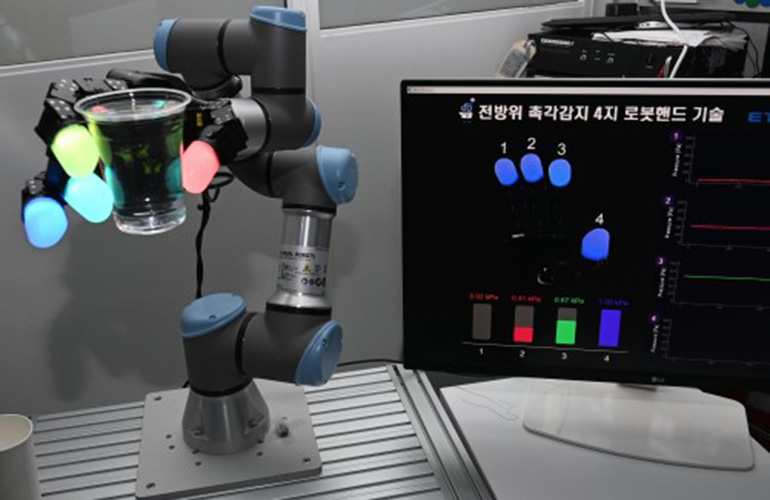
ETRI’s robotic hand with omnidirectional tactile sensors. | Supply: ETRI
Researchers from the Electronics and Telecommunications Analysis Institute (ETRI) are creating tactile sensors that detect stress whatever the course it’s utilized.
ETRI is introducing a tactile sensor that matches right into a robotic finger with stiffness and a form just like a human finger. The robotic finger can flexibly deal with every little thing from onerous objects to deformable mushy objects.
“This sensor know-how advances the interplay between robots and people by a big step and lays the groundwork for robots to be extra deeply built-in into our society and industries,” mentioned Kim Hye-jin, a principal researcher at ETRI’s Clever Elements and Sensors Analysis Part.
ETRI entered right into a mutual cooperation settlement with Wonik Robotics to collectively develop the know-how. Wonik will carry its experience in robotic palms, together with its expertise creating the “Allegro Hand,” to the venture. It beforehand provided robotic palms to firms like Meta Platforms, Google, NVIDIA, Microsoft, and Boston Dynamics. The businesses collectively exhibited associated achievements on the Good Manufacturing unit & Automotive Business Exhibition, held at COEX in Seoul.
Overcoming the technical limitations of stress sensors

ETRI’s robotic hand with tactile sensors additionally consists of LED lights that change colours in response to stress modifications. | Supply: ETRI
ETRI’s analysis crew says its know-how can overcome the technical limitations of stress sensors utilized to present robotic fingers. Beforehand, these sensors may present distorted indicators relying on the course wherein the item was grasped. The crew mentioned it’s additionally extremely rated for its efficiency and reliability.
The sensor can detect stress from numerous instructions, even in a three-dimensional finger type, whereas additionally offering the flexibleness to deal with objects as naturally as a human hand, in response to the crew. These skills make up the core of the know-how.
ETRI was in a position to advance this robotic finger know-how by integrating omnidirectional stress sensing with versatile air chamber tactile sensor know-how, high-resolution sign processing circuit know-how, and clever algorithm know-how able to real-time dedication of an object’s stiffness.
Moreover, the crew enhanced the sensor’s precision in stress detection by together with LED lights that change colours in response to stress modifications. This gives intuitive suggestions to customers. The crew took this a step additional and in addition built-in vibration detection and wi-fi communication capabilities to additional strengthen communication between people and robots.
Not like conventional sensors, which have sensors instantly positioned within the space the place stress is utilized, these tactile sensors usually are not instantly uncovered to the realm the place stress is utilized. This enables for steady operation over lengthy intervals, even with steady contact. The crew says this improves the scalability of purposes for robotic palms.
Waiting for the long run
ETRI says the event of clever robotic palms that may alter its grip energy in response to the stiffness of objects will result in innovation in ultra-precise object recognition. The crew expects the commercialization timeline to start within the latter half of 2024.
Delicate and sturdy robotic fingers may assist robots carry out extra complicated and delicate duties in numerous fields, together with within the manufacturing and repair sectors. ETRI expects that, by tactile sensor know-how, robots will have the ability to manipulate a variety of objects extra exactly and considerably enhance interplay with people.
Sooner or later, the analysis crew plans to develop a complete robotic hand with these tactile sensors. Moreover, they intention to increase their improvement to a super-sensory hand that surpasses human sensory capabilities, together with stress temperature, humidity, mild, and ultrasound sensors.
By way of the crew’s collaboration with Wonik, it has developed a robotic hand able to recognizing objects by tactile sensors and adaptability controlling pressure. The analysis crew plans to proceed numerous research to allow robots to deal with objects and understand the world as human palms do by sensors.