

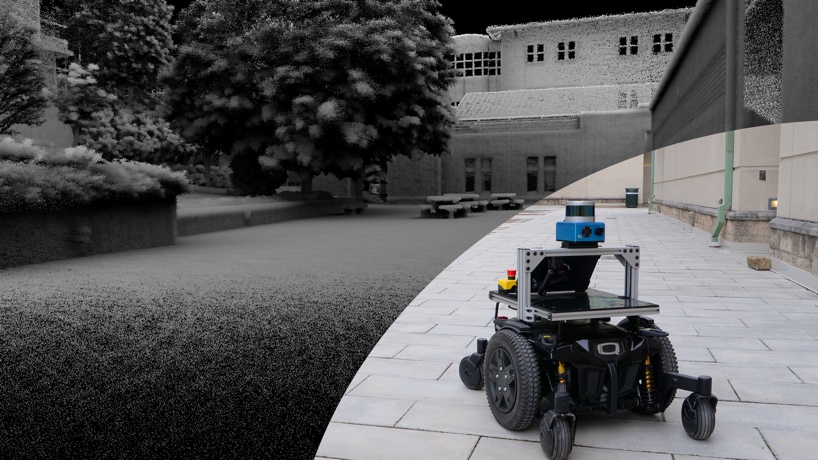
CMU’s Autonomous Exploration Analysis Workforce has developed a set of robotic programs and planners enabling robots to discover extra shortly, probe the darkest corners of unknown environments, and create extra correct and detailed maps — all with out human assist.
By Aaron Aupperlee
A analysis group in Carnegie Mellon College’s Robotics Institute is creating the following era of explorers — robots.
The Autonomous Exploration Analysis Workforce has developed a set of robotic programs and planners enabling robots to discover extra shortly, probe the darkest corners of unknown environments, and create extra correct and detailed maps. The programs enable robots to do all this autonomously, discovering their method and making a map with out human intervention.
“You possibly can set it in any surroundings, like a division retailer or a residential constructing after a catastrophe, and off it goes,” mentioned Ji Zhang, a programs scientist within the Robotics Institute. “It builds the map in real-time, and whereas it explores, it figures out the place it desires to go subsequent. You possibly can see the whole lot on the map. You don’t even need to step into the house. Simply let the robots discover and map the surroundings.”
The group has labored on exploration programs for greater than three years. They’ve explored and mapped a number of underground mines, a parking storage, the Cohon College Heart, and several other different indoor and out of doors places on the CMU campus. The system’s computer systems and sensors will be hooked up to just about any robotic platform, reworking it right into a modern-day explorer. The group makes use of a modified motorized wheelchair and drones for a lot of its testing.
Robots can discover in three modes utilizing the group’s programs. In a single mode, an individual can management the robotic’s actions and path whereas autonomous programs preserve it from crashing into partitions, ceilings or different objects. In one other mode, an individual can choose some extent on a map and the robotic will navigate to that time. The third mode is pure exploration. The robotic units off by itself, investigates your complete house and creates a map.
“This can be a very versatile system to make use of in lots of functions, from supply to search-and-rescue,” mentioned Howie Choset, a professor within the Robotics Institute.
The group mixed a 3D scanning lidar sensor, forward-looking digital camera and inertial measurement unit sensors with an exploration algorithm to allow the robotic to know the place it’s, the place it has been and the place it ought to go subsequent. The ensuing programs are considerably extra environment friendly than earlier approaches, creating extra full maps whereas lowering the algorithm run time by half.
The brand new programs work in low-light, treacherous situations the place communication is spotty, like caves, tunnels and deserted buildings. A model of the group’s exploration system powered Workforce Explorer, an entry from CMU and Oregon State College in DARPA’s Subterranean Problem. Workforce Explorer positioned fourth within the closing competitors however gained the Most Sectors Explored Award for mapping extra of the route than some other group.
“All of our work is open-sourced. We’re not holding something again. We wish to strengthen society with the capabilities of constructing autonomous exploration robots,” mentioned Chao Cao, a Ph.D. scholar in robotics and the lead operator for Workforce Explorer. “It’s a elementary functionality. After you have it, you are able to do much more.”
The group’s most up-to-date work appeared in Science Robotics, which revealed “Illustration Granularity Allows Time-Environment friendly Autonomous Exploration in Giant, Advanced Worlds” on-line. Previous work has obtained high awards at prestigious robotics conferences. “TARE: A Hierarchical Framework for Effectively Exploring Advanced 3D Environments” gained the Finest Paper and Finest Techniques Paper awards on the Robotics Science and Techniques Convention in 2021. It was the primary time within the convention’s historical past {that a} paper obtained each awards. “FAR Planner: Quick, Attemptable Route Planner Utilizing Dynamic Visibility Replace” gained the Finest Scholar Paper Award on the Worldwide Convention on Clever Robots and Techniques in 2022.
Extra info is on the market on the group’s web site.

Carnegie Mellon College