

Though snails are sluggish and slimy-bottomed, they’ve impressed a brand new sort of robotic that might be fairly helpful. Teams of those bots can function independently or be part of collectively as a way to carry out duties that may in any other case be unattainable.
Lately we have heard loads about “swarm robotics.”
This idea includes using small robots that may work both on their very own or as one side of a bunch of similar bots. Within the latter situation, all of the robots talk with each other, coordinating their actions as a way to get the job achieved.
That job may entail trying to find survivors at catastrophe websites, performing reconnaissance in hazardous environments, and even exploring the surfaces of different planets.
For some purposes, the robots should bodily hyperlink up with each other.
As a result of aerial and underwater bots can transfer each horizontally and vertically, they’re in a position to type three-dimensional shapes when joined collectively. Against this, as a result of terrestrial (ground-going) robots can solely transfer horizontally, they’re restricted to forming two-dimensional shapes – thus limiting their potential makes use of. What’s extra, a lot of the experimental fashions created to date can solely transfer throughout clean, flat surfaces.
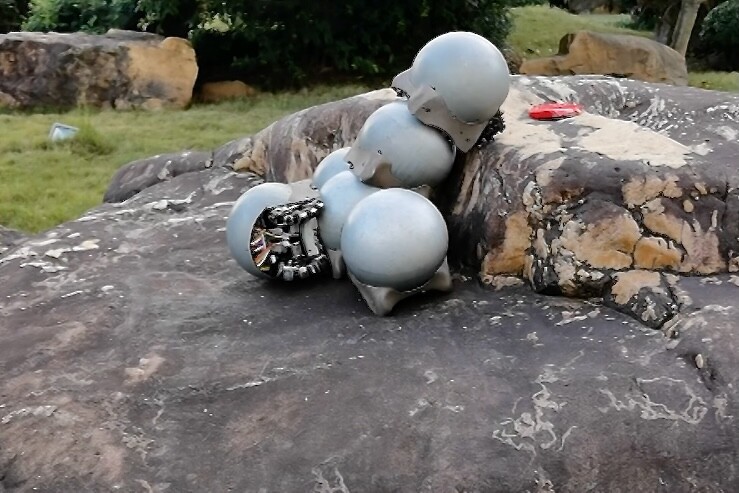
Issues can be totally different, nevertheless, if there have been “off-road” terrestrial bots that would climb up on prime of each other, stacking themselves into three-dimensional configurations. That is the place the brand new snail robotic is available in.
The Chinese language College of Hong Kong
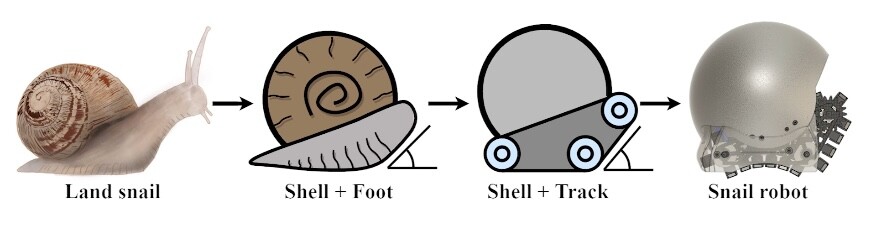
Developed by Da Zhao and colleagues at The Chinese language College of Hong Kong, the system was impressed by the White Jade land snail. Like that gastropod, it might probably transfer itself alongside whereas doing a fairly good job at sticking to surfaces, however then cease and use suction to type a a lot stronger bond when wanted.
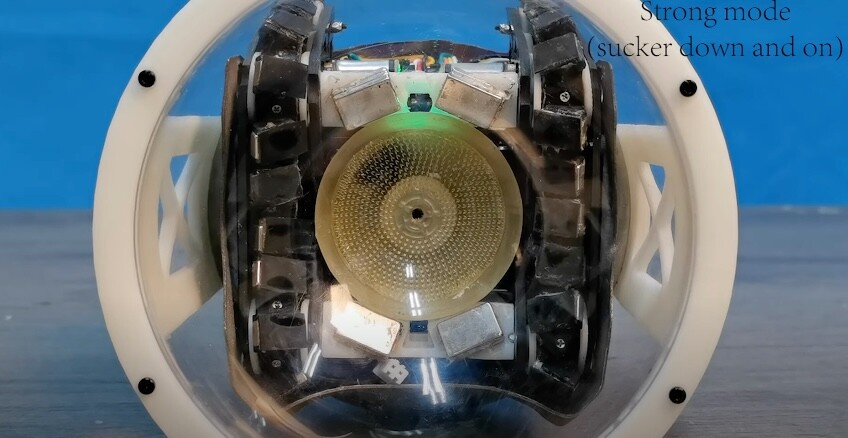
The robotic has a spherical ferromagnetic iron shell, within that are a battery, microprocessor and different electronics. On the underside of that shell is a set of tank-like tracks fabricated from rubber with embedded magnets. A retractable vacuum-powered suction cup is situated between the 2 tracks.
The Chinese language College of Hong Kong
When the robotic is shifting in “free mode,” the suction cup is stored withdrawn and unpowered. The bot merely strikes throughout each clean and uneven terrain on its tracks, using the magnets in these tracks to climb up on prime of the shells of different snail robots.
As soon as it is in place up there, the bot switches to “sturdy mode” by decreasing and powering up its suction cup. That cup then clings tightly to the shell of the opposite robotic, holding the 2 bots firmly collectively. That mentioned, the robotic’s shell can nonetheless rotate relative to the cup, permitting it to pivot on the spot with out dropping suction.
The Chinese language College of Hong Kong
In outside checks carried out to date, swarms of the snail robots have labored collectively to carry out duties akin to climbing up over ledges, making their manner throughout gaps, and forming a single robotic arm. Though the bots had been remotely managed for these experiments, it’s hoped that their descendants might in the future do such issues autonomously.
You’ll be able to see the snail robots in motion, within the video bellow. A paper on the analysis was just lately printed within the journal Nature Communications.
And must you be upset that the bots do not look that a lot like actual snails, try the self-healing robo-snail that was created final 12 months at Carnegie Mellon College.
[Nature Communications] Snail-inspired robotic swarms
Supply: Nature Communications