

|
Take heed to this text  |
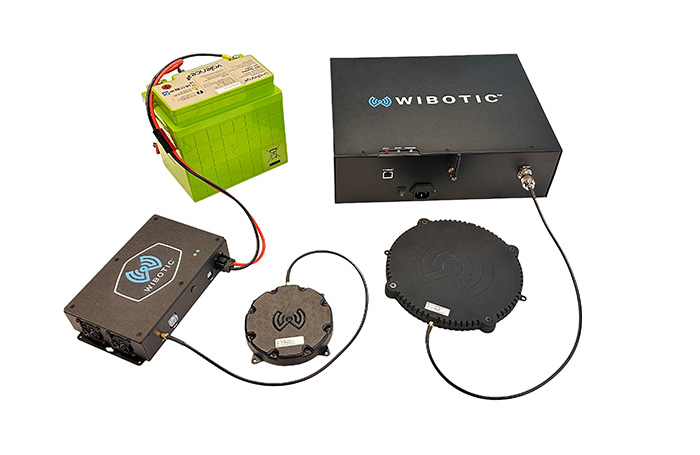
WiBotic 1kW System (battery not included). | Credit score: WiBotic
WiBotic right this moment unveiled a brand new 1kW wi-fi charging product for larger-capacity battery methods. The Seattle-based firm has made a reputation for itself within the cellular robotics market by offering contactless charging as an aftermarket various to OEM contact-based altering methods. The prior product hyperlink included 150-watt, 250-watt, and 300-watt wi-fi charging choices.
The brand new higher-power 1kW system opens a complete new class of machines for wi-fi charging, mentioned WiBotic. It makes use of 110v energy and a minimal 30 amp circuit, delivering the upper energy with out the necessity for three-phase supply facility energy circuits.
The WiBotic Commander software program will handle the charging present primarily based on supply energy circuit traits, in order to not journey a facility energy circuit.
WiBotic says contactless charging guarantees advantages
The benefit of shifting from contact charging to wi-fi charging is twofold, in accordance with WiBotic.
First, with contact charging, methods must be manually linked and disconnected to the charger, it mentioned. Some automated guided automobile (AGV) and self-driving automobile producers present autonomous contact chargers, however these methods use proprietary connectors.
Finish customers that deploy cellular robots with contact chargers from multiple OEM will finally find yourself with a wall of devoted charging stations that may solely be utilized by particular robots. That is inefficient and takes up essential facility flooring house, the firm famous.
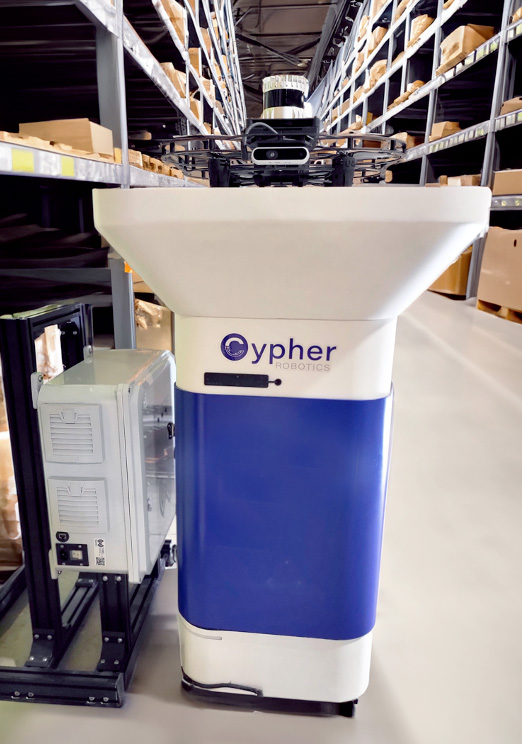
Cypher Robotics cellular robotic in a warehouse – with built-in drone pad for aerial stock – docked to WiBotic’s Edge transmitter. | Credit score: WiBotic
“WiBotic’s new wi-fi 1kW charging platform enhances operations,” acknowledged Peter King, vp of Cypher Robotics Inc., an Ottowa-based supplier of warehouse AMRs and drones.
“We’ve efficiently deployed WiBotic chargers for patrons in a spread of functions and in some tough environmental circumstances — however traditionally solely in functions the place in a single day charging was potential,” he mentioned. “With the brand new 1kW system, robots will cost at 3 times the earlier pace, opening up a complete new set of functions the place quick and ultra-reliable charging is required.”
The second benefit of wi-fi charging is within the uniformity of the charging infrastructure, mentioned WiBotic. Any accessible wi-fi charger station in a facility can be utilized by any robotic within the fleet in want of a recharge.
Relying on the variety of cellular robots in an finish person’s fleet, this idea can vastly simplify the charging course of, claimed the corporate. Facility operators can place wi-fi charging stations at varied websites to allow them to utilized by any autonomous cellular robots (AMRs).
Wi-fi communication for operational knowledge
When retrofitting a cellular robotic with the WiBotic charging system, a sensible charger controller unit must be put in onto the AMR. This sensible charger autonomously manages the ability switch from the wi-fi charging pad to the cellular robotic unit.
WiBotic has an open API [application programming interface] that allows an AMR to simply talk with the onboard sensible charger.
The sensible charger then wirelessly communicates with the powered pad to regulate the circulate of power wirelessly between the supply pad and the onboard energy receiver. With the brand new 1 kW energy system, it could switch extra power, extra rapidly, to bigger cellular robots, mentioned WiBotic.
Utilizing a proprietary wi-fi communication channel, the onboard charger may also relay statistical info and different knowledge, not solely in regards to the onboard battery, but additionally from the robotic controller. This knowledge dump is separate from any Wi-Fi or 5G communication connection to the robotic and gives OEMs with an alternative choice for knowledge switch and communications.
Ben Waters, co-founder and CEO of WiBotic, described the sensible communication characteristic:
“This higher-power product permits us to get into markets that aren’t robotic, machines like carton handlers, pallet jacks, and floor-cleaning automobiles. There are a variety of battery-powered automobiles on the market right this moment that aren’t but robotic or autonomous. They’re simply dumb gadgets within the sense that they aren’t linked gadgets, and OEMs don’t have a option to remotely discuss to them. By including wi-fi charging to their gadgets, additionally they now can talk knowledge from the gadgets. It may be a easy diagnostic, like: ‘What number of hours does my flooring scrubber have on it?’”
The corporate has additionally developed its personal administration software program, WiBotic Commander. Clients can simply monitor the charging standing and battery well being of total fleets of robots in actual time. Charging procedures can then be applied proactively to fluctuate cost present and voltage to dramatically improve battery lifespan.
Whereas finish customers can buy and deploy the wi-fi chargers, WiBotic has centered on constructing relationships with OEMs and serving to to combine their cellular robotic controllers to the WiBotic energy controller. The WiBotic controller may also work with contact chargers, offering cost administration choices for any cellular robotic energy want.
“We [primarily] work with two sorts of prospects,” mentioned Matt Carlson, vp of enterprise growth at WiBotic. “We work with the OEMs providing the robots as a service, however they’re the corporate who builds the robotic, after which they supply it to the top buyer. So with these prospects, we work with their engineering groups very carefully.”
“In some circumstances, we work with the top buyer, the place they could function a number of robots or various kinds of carts,” he added. “And for one purpose or one other, charging is a large downside for them. It’s a giant price as a result of on the finish of every single day, some worker has to cost all of the batteries on the entire robots, to organize for the subsequent day.”
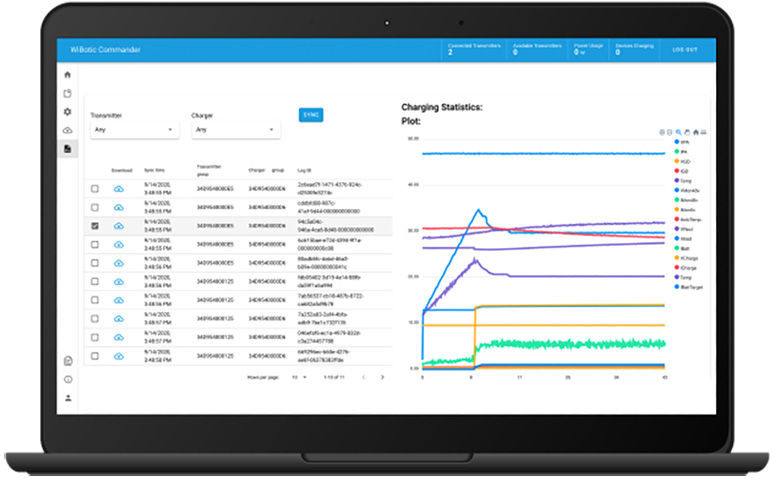
The Wibotic Commander software program is a ‘single pane of glass’ for managing the charging of a robotic fleet. | Credit score: WiBotic
Greater-frequency charging helps stop inductive heating
One other key characteristic of WiBotic’s system, in accordance with Waters, is that it makes use of larger radio frequencies for power switch than a few of its rivals.
“A few of these inductive methods function at a decrease frequency, usually between 50 and 200 kilohertz,” he advised The Robotic Report. “WiBotic makes use of 6.78 megahertz, which remains to be means beneath all of your Wi-Fi [communication].”
WiBotic mentioned its platform reduces security dangers from electrical shorts and hearth threat from sparking throughout contacts, making it appropriate for environments the place filth, mud, water or corrosion can result in failed charging cycles.
“However there are some essential technical benefits, particularly on the larger energy ranges,” mentioned Waters. “One is that we don’t warmth overseas objects. Inductive heating methods are additionally on this vary, so if there may be some unfastened steel round, it could warmth up [as a side effect]. Quite a lot of [our competitors] have very sturdy overseas object detection, which is nice. It will stop steel objects from heating up, nevertheless it’s going to cease charging.”
“So working on the larger frequency and including in a number of the issues that we do round our adaptive tuning [means] we don’t have this phenomenon of heating steel objects,” he mentioned.
WiBotic plans to show its new 1kW system at Sales space 4087 close to the ARM Demo Space at Automate in Chicago subsequent week.
 Be taught from Agility Robotics, Amazon, Disney, Teradyne and lots of extra.